Friday, March 21, 2014

New Projects: ZAZI Girls Club and Computer Class

ZAZI Girls Club 
“Recent research and statistics suggest the need for a renewed focus on sexual and reproductive health for women and girls in South Africa. Teenage pregnancy, the relatively low uptake of contraceptive services, and women’s vulnerability to HIV and STIs and other critical issues prompted SANAC Women’s Sector to partner with USAID/JHUHIV, PEPFAR, DWCPD, DOH, and DSD to create a national campaign to champion women’s health, rights, and empowerment. The campaign was officially launched in May 2013” (ZAZI 2013).

“The ZAZI campaign encourages women and girls to draw on their inner strength, power, and self-confidence to know themselves and what they stand for in order to guide their decisions about their future. The campaign has advocacy, mass media and community mobilisation activities. The ZAZI campaign was designed by women for women, and seeks to help women ‘know their strength’” (ZAZI 2013).
...
Phindile, Wendy, Zikhona and I have begun a weekly group using the ZAZI campaign’s 10-session toolkit for women’s sexual and reproductive health. Ezakheni Township’s first ZAZI Girls Club has 18 Grade 10 and 11 learners from Ekukhuleni High School. The girls are 15-19-years-old, on the younger side for the programme, but nonetheless eager to participate in the campaign. I’ve adapted some sessions and activities, but for the most part, the toolkit hits on critical issues that affect women and girls of all ages in South Africa.
Sexual and reproductive health should be covered in Life Orientation and Biology classes, but sadly, young men and women have lots of unanswered questions, bad explanations, and not enough reliable sources for sound information. Virginity, sex, and the body are still taboo topics in many ways. For instance, there are no words in isiZulu for female or male genitals. Inside and outside of the classroom, reproductive and sexual health is discussed in vague terms. Enter: the ZAZI campaign. Each session covers relevant topics and information women and girls.

Last week we focused on how the male and female reproductive and sexual health systems actually work, breaking down one body part at a time. Talking about anatomy in a safe space leads to the most surprising questions and discussions. We addressed myths about the body, and social expectations for men and women regarding sex, virginity, parenthood, and sexual expression. (They were obsessed and slightly horrified with how tampons work, even bunking an extra of mine in a cup to watch it absorb water. Most of them have no interest in using tampons, but they were very curious about where they go, how they work or if they affect virginity.)

We are a month into our first ZAZI group. The girls are more cohesive, engaged and motivated with each session. They want to come, learn, and share. Two of my co-facilitators are mothers in their 40s, while Zikhona is 21. We make up an unusual team of facilitators, but somehow it really works. Wednesdays are no longer hump days, but ZAZI days. I can’t wait for next week’s session on life changes, where we’ll cover puberty, menstruation and menopause.

Computer Class


The previous PCV in Ezakheni, Samantha Croffut, organized the donation of 20 computers from the Council of KwaZulu-Natal Jewry in Durban. Yes, that’s right. Jews in Durban donated 20 working computers to Nswelamanzivela Primary School in Ezakheni Township! It is a huge deal for a school to have working a computer lab, a basic computer literacy course for learners or even a computer-literate staff. Thanks to Sam’s efforts, we are tackling all three! After over a year-and-a-half of securing the donations, preparing the room and setting up the computers, the computer lab was officially launched last October.

I would, in no way, consider myself a particularly computer savvy person. Despite this, I offered to help train trainers (aka teach the teachers) basic computer literacy—how the computer works, Word, Excel and Power Point. Lots of PCV have done similar projects, so I had lots of curriculum to draw on when putting together a basic computer literacy course for adults. 

Once Term 1 got underway, I started classes with eight interested teachers (and the principal, when she can make it). We meet after school on Tuesdays and Thursdays, and I’ve got to say, these ladies are fabulous! At first it was a bit daunting to go into a classroom and teach teachers twice my age. By the second week however, their motivation, commitment and humor made our weekly classes the highlight of my week. 

I am so proud of their progress. In just eight sessions they have mastered so many skills. One woman, Mrs. Xaba, is so into the class that she even purchased her own laptop last week. I never expected to be teaching in a computer lab during my Peace Corps service, but it’s been a great project. Once these ladies are confident in their skills, I’ll work with them to develop and launch a feasible computer programme for their learners.


Thursday, March 20, 2014

2014 Breakthroughs

Dear Everyone,

There is no getting around it—I need to be in better contact with everyone back home. I have to make more time to share what is happening “this side”. I have neglected my blog, long update emails and even facebook messages for far too long. So to make up for it, I’ve decided to write a few short updates on neat things that have happened over the past few months.

Towards the end of my three-week trip back in December and January, I started to feel intense pressure and anxiety about starting my second year of service. Reflecting on my first year meant acknowledging that time works differently here. I also had to accept that staff changes at work, lack of time and apathy would make some proposed projects not feasible for 2014. Now that I’ve acknowledged these unavoidable constraints and limitations, a weight has been lifted. Given all of this, one more year just suddenly doesn't feel like enough time. I spent much of my first year building relationships and wrapping up the previous volunteer’s projects. I have just over 12 months left in my Peace Corps service, and there is so much left to do.

Around that time, I decided that unless something disrupts my service, I completely and totally want to extend for a third year. I love living and working in Ezakheni, KZN, South Africa. And despite the challenges, frustration, and slow pace of “getting things done”, I love being a Peace Corps Volunteer in South Africa.


I also started working through what I want to do and where I want to be after I return to the States. It has taken me awhile to arrive at this point, but I have decided that I want to return to the States to pursue a Master’s of Social Work. I have been always been inspired by my mother’s work at Sutter and motivated by what I have seen in my township. Social work feels like the natural fit. I have begun looking at six different MSW programs throughout the country. All of the schools currently on my list are outside of California. After moving to South Africa, moving to a different state feels like a great opportunity and the right move. My tentative plan is to study for the GRI and apply for grad school during my third year in South Africa. I hope to begin grad school in Fall 2016.

So, my dear friends and family, this is my current/tentative/feels right plan for the next few years. It I most likely won’t return to the States as planned in March 2015, but will return home with purpose the following spring.

I continue to love the challenge of grassroots-level development, and the unexpected joy that tiny, seemingly insignificant breakthroughs with people can bring. I’m looking forward to 2014 here in Ezakheni, 2015 in someplace new, and hopefully 2016-2018 in a great MSW programme.

Siyabonga kakhulu / thank you very much for all of your support.

Much love,
Hannah / Thandiwe


Tuesday, November 19, 2013

Traditional Wedding : A day of slaughter, dance and community

Key Words
Umshado wesintu – Traditional Zulu wedding
Ymgido wesintu - Traditional Zulu dance
Umakoti - Bride
Umkhwenyana - Groom
Umqombothi – African beer
Umemulo – Coming-of-age ceremony
Umembeso – Engagement ceremony
Lobola – Dowry; the gifts exchanged between families
Gogo – Grandmother
Yebo – yes
Ubuntu – Nguni Bantu term related to humanist philosophy, meaning ‘I am because you are’

Traditional Zulu celebrations are huge, costly affairs that take many months or years to plan. They involve the entire extended family, neighborhood, and for prominent families, the whole community. Hundreds of people come together to celebrate a passing, wedding, birth, engagement or coming of age ceremony. One of the first events I attended was an umemulo ceremony in rural Masinga, where three rural Zulu young women celebrated their virginity and eligibility for marriage. In more urban areas, if often marks women’s 21st birthday. Next I attended an engagement ceremony umembeso, where the families of the bride and groom presented each other with lavish gifts as part of the lobola. Most gifts were surprisingly practical: large cooking pots, grass mats for entertaining, piles of warm blankets for winter, tailored suits patriarch, and beautiful dresses and aprons for the women of the family. These ceremonies all lead up to the main event—the traditional Zulu wedding.

Engagements can last years, as the lobola is slowly paid to the bride’s family and both families gather contributions to pay for the actual wedding. In my township, couples have a white church wedding followed by a traditional Zulu wedding at the home the following day. It is an exhausting ordeal not only for the bride and groom, but the entire family and neighborhood that help to make it happen. Weddings are community events, where guests and uninvited community members come together to celebrate the joining of two families.

The bride and bridal party just before her official
entrance into the groom's family home.
Phindile, (one of my favorite Community Care Givers at Sikhona Care Centre) invited me to attend her brother’s wedding last Friday. As it was my first wedding, my first and only question was “What should I wear?” Laughing at my concern, she told me to “wear trousers, a skirt or a dress” and meet her at corner by Eskom Electricity 11:30am Sunday. Knowing that Phindile would try to look out for me while juggling her hosting duties, I said “Yebo”. It’s always a bit nerve-wracking to show up to an event, not knowing if my presence will lead to lots of puzzled looks, sexual harassment or welcoming embraces. Usually, I get a mix of all three. After waiting under a tree for 20 minutes, I jumped into a packed pick-up truck and drove into the edge of Section A armed only with a water bottle, camera, and tissue (aka toilet paper). The road was already packed with cars. The big event tent blocked the entire road, effectively shutting down the whole street for the wedding. As we pulled, up I saw three other white guests, who I was immediately introduced to. Sam, Boris and Chad work with the groom at a wildlife documentary company in Durban. Knowing that there was a sizable group of guests from Durban was an instant relief, as it would mean that at least a few guests would speak English. We were shepherded out of the tent and taken next door to a shady spot under a pine tree. Slowly more guests joined us, bringing cold drink and plates of cookies. A large group of Zulu dancers arrived, unpacking bags of clothing and beads behind us. In the States I would never dream of sitting in a stranger’s front yard for yours, but here it felt normal.
The Zulu dancers that befriended me before the wedding.

For the next two hours we sat around, watching the men slaughter a massive cow in the front yard of the hosting family’s home. Women are not involved in the slaughter or butchering at all, only coming into contact with the meat as it’s cooked in heavy pots. Older men watched the butchering from just beyond the fence. They sat on stones from the road and drank from communal jugs of umqombothi. By the time the ceremony started, these men were drunk and eager to dance.

Nothing ever seems to start on time in South Africa, and on Sunday, the wedding was no exception. By the time things not going, the wedding was a good three hours behind schedule. To fill the time, I decided to meet the Zulu dancers lounging in the shade, practicing dances and texting friends behind me. They all come from Section E, the one section of Ezakheni I’ve never visited before. The girls were mostly in Grade 7-10 and were probably somewhere between 12-17 years-old. I spent the next hour taking photos, joking around and learning about their costumes. A few boys wandered over too, but for the most part, the girls held my attention. They were precocious and hilarious. These dancers formed the backdrop of all of the traditional aspects of the ceremony. They led the bride out of the house in her white dress and sang as she made her formal entrance into her husband’s home behind the wedding chest. The dancers also escorted the groom and groomsmen out of the house, first in their white wedding attire and later clothed only in their Zulu animal skins.

There seemed to be an unspoken order to events once the wedding started. The bride made her official entrance into the Radebe home, she walking around the yard with her bridesmaids and female members of her family. As the bride’s procession wove in and out of the crowd, older women sang and danced in the bride’s honor. Once the bride was settled under an umbrella, the groom made his formal entrance. At that point, the celebratory dancing began in earnest. The dancer troop preformed wedding songs and dances, growing in intensity and complexity. Everything they did was captivating—their high kicks and stomping sent dust flying over the crowd. A few drunken old men occasionally wandered across the grassy stage, but for the most part the dancers performed uninterrupted for over an hour. 
Gifts for the family of the groom--
every member will receive a blanket.

The Zulu dancing kicked off a series of traditional wedding activities. A mountain of gifts was bestowed to the groom’s family, while people danced forward to give money to the new couple. The final act was to assemble a brand-new bedroom set, complete with pillows and sheets. The bride and groom stepped forward into their pretend bedroom. Both clad in traditional Zulu clothes, the bride washed her husband’s feet and helped him into bed. At this point the crowd erupted. Bridesmaids and women from her family ran forward to beat the groom with sticks (luckily, he was safe from the beating thanks to a new thick blanket). This dramatic, hilarious ruckus marked the end of the ceremony. From this point on wards the bride would stay in the home of the groom, slowly earning her place as a member of the Radebe family. I’ve heard stories of mistreatment, jealousy and down-right contempt of brides, but in this case, the bride will most likely return to Durban with their children after a few weeks of fulfilling her duties as umakoti. Brides are expected to clean and clean for their in-laws, slowly earning respect and a place in the family.

Zulu dancers waiting around next door
before the wedding.
After six hours at the wedding, I headed home. The folks from Durban gave me a lift out of Section A so I wouldn’t have to walk past 150+ drunken men starting to pour out of the large shebeen next to the wedding. Although it was time for me to make a graceful exit, the wedding festivities lasted well into the night, as guests traded cold drink (soda) for barrels of communal local brew and bottles of liquor. I walked home incredibly happy and satisfied. Traditional Zulu ceremonies are powerful to witness, full of dancing, singing, drinking and feasting. I love how the entire community participates by raising funds, cooking and celebrating with the family. Hosting a massive, 400-plus person wedding without an enforced guest list would be a nightmare in the States, but somehow the openness of it works here. Traditional Zulu weddings exemplify the spirit of ubuntu, bringing together family, friends, and neighbors to celebrate the joining of two families. 

Tuesday, September 10, 2013

Over the hills and through the bush we go...

Walking to Bhekintuthuko from Ezakheni
For the last month, I’ve been helping my organization’s Community Care Givers (CCGs) implement Grassroots Soccer (GRS) at Bhekintuthuko High School. Grassroots Soccer is a popular project for Peace Corps Volunteers here (mainly because implementing it is enjoyable, low-cost and effective). Through soccer and other interactive games, youth learn about HIV transmission, prevention and treatment. Learners (students) open up quickly during these sessions, taking advantage of the safe space to ask questions about everything from sex and relationships to HIV, STIs and general health. GRS was first implemented by the volunteer before me—she organized trainings for our organization’s CCGs and interested folks from the local Department of Social Development office, successfully implemented with hundreds of learners from multiple schools in the area, and put on concentrated GRS day camps for youth. Grassroots Soccer has been very successful in this area, where having unprotected sex is common practice and HIV rates are high. Youth also gravitate to the open, safe environment the CCGs create in the classroom or out in the yard. Unlike their Life Orientation classes, GRS deals with taboo topics that youth (usually age 14-21) are dying to know more about: sex, relationships and HIV. The program is broken down into 11 sessions, with a pre-quiz and post-quiz given at the beginning and end of the intervention. A graduation is held for learners at the end. It’s a chance for them to share what they’ve learned through original poems, dramas or songs. Feedback from past interventions is overwhelmingly positive. The program is very youth-friendly, but the CCGs make it an enjoyable and educational program by bringing their own life experiences, dance moves and infectious energy to each session.

The narrow path learners use to get to school
Bhekintuthuko—Bheki for short—is the major high school in Mctheni, the rural area that borders Ezakheni Township. From my house on the edge of Section D, it takes a good 45 minutes to walk to Bheki. The trail is rough, dipping down into dry creek beds and up over fences separating properties. The path winds its way through the bush, binding smaller household footpaths together. This area is rural, with only multi-generational compounds and the occasional communal tap dotting the hills. Families are mostly subsistence farmers, planting maize on rocky plots. They also keep herds of scraggly goats, which roam free during the day and somehow find their way back to the corral at dusk. Wealthier families own cows, which are used to pay dowries (labola) or slaughtered for Zulu ceremonies. Work is constant, but can easily go unnoticed if you’re looking at the ground to avoid tripping on rocks along the uneven path. After bush fires, women chop down small thorny trees for firewood, steadily moving across the newly charred landscape. Men are less visible, tending to the livestock or sitting at home drinking local brew. Although Ezakheni is just over the hill, the township feels far away.

Every school day learners make the trek from the all corners of the township to attend school at Bheki. It is
Grassroots Soccer Coaches
hard to pinpoint what motivates learners travel so far to attend school in the rural areas. From 6:15 in the morning, clusters of learners flock through my neighborhood on their way to Bheki, slowly trudging back in the afternoon heat.

Grades are broken down by classroom, i.e. Grade 10A, 10B and 10C. The A, B and C mean more in the higher grades. Top students, usually focused on the sciences or mathematics are in the A class. How learners actually get divided into the three classes is beyond me, especially when 30-40% is a passing grade. With anywhere from 50 to 70 learners in each class, the classrooms feel cramped. The rooms are simple, fitted only with a chalkboard and desks. Like any high school, learners sit with their friends. Younger girls and boys usually sit in front, while the older learners rule the back of the room. Unlike high school in the US, where students are usually roughly the same age, in South Africa the age of learners in a given class can vary widely. There will be 14 and 21 year-olds in the same grade, usually because of the high fail rate. Learners are routinely held back after failing one, sometimes multiple years. The pressure on learners is intense—the math and science they are expected to understand is far more advanced than what is taught in the US. Despite rigorous coursework, the fail rate is high. Teachers are often ill-equipped (or lack the motivation) to get learners exam-ready. In high school exams are administered in English. This becomes a challenge for most learners because subjects are routinely taught in isiZulu. South Africa has 11 official national languages, but exams for upper primary and secondary
learners are held in English. Again and again, this becomes a problem for learners.

Grade 8 learners who completed GRS last term
It is easy to critique South Africa’s education system. It is easy to find fault with teachers’ liberal use of corporal punishment or lackluster teaching methods. On the other hand, I keep trying to look for things that are working or going well. Learners at Bheki are eager for information. The CCGs and I get routinely get brazen questions about sex, relationships, health, jobs, marriage and everything in between.  It feels good to be able to relay or research information to share. The daily trek is tiring but oddly satisfying. I never thought I’d find myself teaching sex ed to teens in a rural high school, looking up the history of latex condoms, or facilitating conversations about virginity, but there you had it.

More stories from the field (the bush, really) soon.


Saturday, August 24, 2013

Weekend Away, Part II: Umemulo Ceremony

SATURDAY
Driving to Kathleen’s rural site, we were transported from a dusty township to a mountainous area, dotted with rondevals, hordes of mangy goats, and bright orange desert flowers.

Mesinga is beautiful. In just one hour we were in a completely different area, governed by traditional leaders and Zulu customs. Women do not wear pants there, so we were clad in our finest mid-calf length skirts. We were also prepared for two days of conserving water. With limited bathing opportunities ahead of us and a lack of available drinking water, we brought supplies—baby wipes and two liter water bottles—to ensure we did not deplete Kathleen’s water supply.

Once we settled into her one-roomed house adjacent to the main house, toured the property and cooed at the pen full of baby goats, we set out for a picnic lunch along the banks of Tugela River. We walked past quiet compounds, each with a coral for livestock. Groups of women sat under trees, calling out to us as we passed. The whole area was quiet, still in the heat. A few kids fished from rocks at the river, but for the most part, we ate in solitude under a new metal walking bridge.


Saturday afternoon was filled with lots of lounging, playing games with neighbor kids and an isiZulu lesson with Kathleen’s sheepish high school tutor. It is incredibly refreshing to spend a weekend away from site with other volunteers. We find ourselves swapping stories and commiserating. I am very fortunate to have these ladies within a two hour distance from my site.

SUNDAY
We woke up to the sound of neighbors greeting Kathleen’s host family. Sunday was the big day, the reason we had made the trek. We were there to attend an umemulo for two girls in the community. In Zulu culture, this coming of age ceremony usually happens when a girl turns 21. It is her official debut into society, marking her availability for dating and marriage. In the rural areas, girls frequently become pregnant as teens, so the ceremony is often held when girls are 16, 17 or 18 years to ensure they are still pure. If they pass a virginity test performed by a well-respected gogo (grandmother) in the community, Zulu men dressed as warriors dance at the ceremony.


The umemulo took place at on a nearby compound. At 11am we met with Kathleen’s counterpart, Gugu, who would be our guide during the ceremony. Once we arrived at the compound, she introduced us to the host family and found us small jobs to help out with. The men and women had different tasks that day. Women of all ages were busy preparing food for 200+ people. There was lots of scurrying about, drying dishes, peeling potatoes and washing veggies. The kinds ran around, half dressed and unable to sit still. In the lower part of the compound, young women were busy getting dressed. Dark pleated skirts were painted black with ash. Beads and headdresses were secured onto bare-breasted young women, nervously preparing for the dancing. Each age group at their own outfits.

At about 1pm, the ceremony began. The young women began in the corral, an important cultural place that women are not allowed to enter outside of ceremonies. All of the dancers circled the property, singing and dancing. After that, everyone followed them down to a field. Crowds of neighbors gathered as the ceremony began. Each young woman danced with tin cans tied to her ankles. Groups and individuals would move in front of the line to perform lots of high kicks, hip-shaking and can-whacking. Men, old and young, would then enter the group with shields and spears raised. These warriors were encircled by young women, a kind of taunting dance between the two sexes. It was very exciting to watch—all of the colors and sounds of Zulu culture on display in front of it. As the dancing continued, more groups of older women joined the young women. Each group had a distinctive outfit, color scheme and hat. These women were married and wore capes to indicate their status. The warriors arrived in a cloud of dust, spears raised. They marched in, chanting and encircling the whole group. At this point, the audience had swelled to several hundred people. Women and children stood watching in the front, while men drank in the back. A group of highly respected men sat on benches, occasionally participating in the warriors dances.

After about two hours, we all followed the retreating dancers up to the compound for food, alcohol and sporadic dancing. The men all moved into the corral to eat from platters of goat and cow meat. The heavy drinking began, which led to several colorful encounters with drunk warriors, all very interested in the four American girls wandering around.

By the time we made it back to Kathleen’s house, dust had set in. The air was chilly, in stark contrast with the blaring heat of the afternoon.  

The next round of umemulo ceremonies won’t take place until December. They happen during school holidays, so the girls have time to go door-to-door for donations and learn the dances. The girls don’t bathe for a week leading up to the big day. They also must dawn the insides of a goat (or maybe a cow?) which is stretched into a kind of cape. It is a huge production, a right of passage that the whole community is involved with.  


Wednesday, July 24, 2013

Weekend Away, Part 1: Youth Talent Show


FRIDAY
Two weeks ago I set out for a long weekend visit to two PCVs’ sites near Weenen Town and Tugela Ferry. Three uneventful taxi rides landed me in Ezintendeni, a small township outside of Weenen. The township was covered in dusty roads and cinderblock houses. Just beyond the hilly township, the well-irrigated fields of white South African-owned farms bring meagre seasonal employment and abundant produce to the area.

I was there to calm Allie’s nerves and lend a hand in her first event as a PCV—a youth talent show designed to re-introduce the community to one of the youth development organizations she works for.

The event was a huge success. Loads of kids and youth (18-35 in South Africa) paid r3 to come into the community hall, gobble down snacks and perform. In true South Africa fashion, the event was supposed to begin at 10am, but did not get going until around 1pm. Flip-chart covered windows kept sneaky youth from peeking in. A few local police attended not to police exactly, but to join the throng of tiny community members in the audience.

The first act was probably my favourite—four tiny girls dressed in their finest outfits walked slowly from one end of the hall to the other with their hands on their hips. Although they had no real talent to judge, they were pretending to be models and it was adorable.  The girls were followed by a slew of lip-syncing acts set to rap songs.  All in all there must have been six separate duos that came up to do pretty much the same act. Two traditional Zulu dance troops performed, with lots of singing and traditional dance numbers in between. Unlike American school or camp talent shows, it was common place for a group to perform more than one number at a time. Each set of amateur lip-syncing rappers performed three songs, one after the other. How strange and hilarious, right? Another key difference was that no family members came to watch their kids perform. In the States I remember talent shows would mostly be attended by parents with video cameras and bouquets of flowers for their kids. Here, most of the audience also performed. No parents or adults came.

I was on concession duty at the back of the hall during the show. Little ones came again and again to buy sweeties (lollipops), nik naks (small bags of corn puffs that turn your mouth violent shades of red or orange), flyers (perfectly round flavoured “popcorn” puffs) and 50 cent oranges from local farms. By the time the show ended at 4pm, the flour was littered with r120 worth of peels, wrappers and bent lollipop sticks. A tiny horde of children helped me clean up the evidence and haul away the trash.

Although I didn’t perform, helping out was oddly exhausting. After we cleaned the place up, Allie, Melinda and I retreated to Allie’s one room house for chockiets dipped in high quality instant coffee (yes, Nescafe is the good stuff) and Melinda’s homemade pizza.

The next morning we packed up to visit Kathleen’s site, a bumpy 1 hour taxi ride through Weenen and up into the mountains.


A house on the edge of the township,
with farmland just behind it.
Youth performing traditional Zulu dances.
Proud first palce winners.
Thier talent? Lip-sycing rap songs.
The adorable first act models.
Ezintendeni Township,
located just outside of Weenen, KZN


Saturday, June 22, 2013

Home Visits


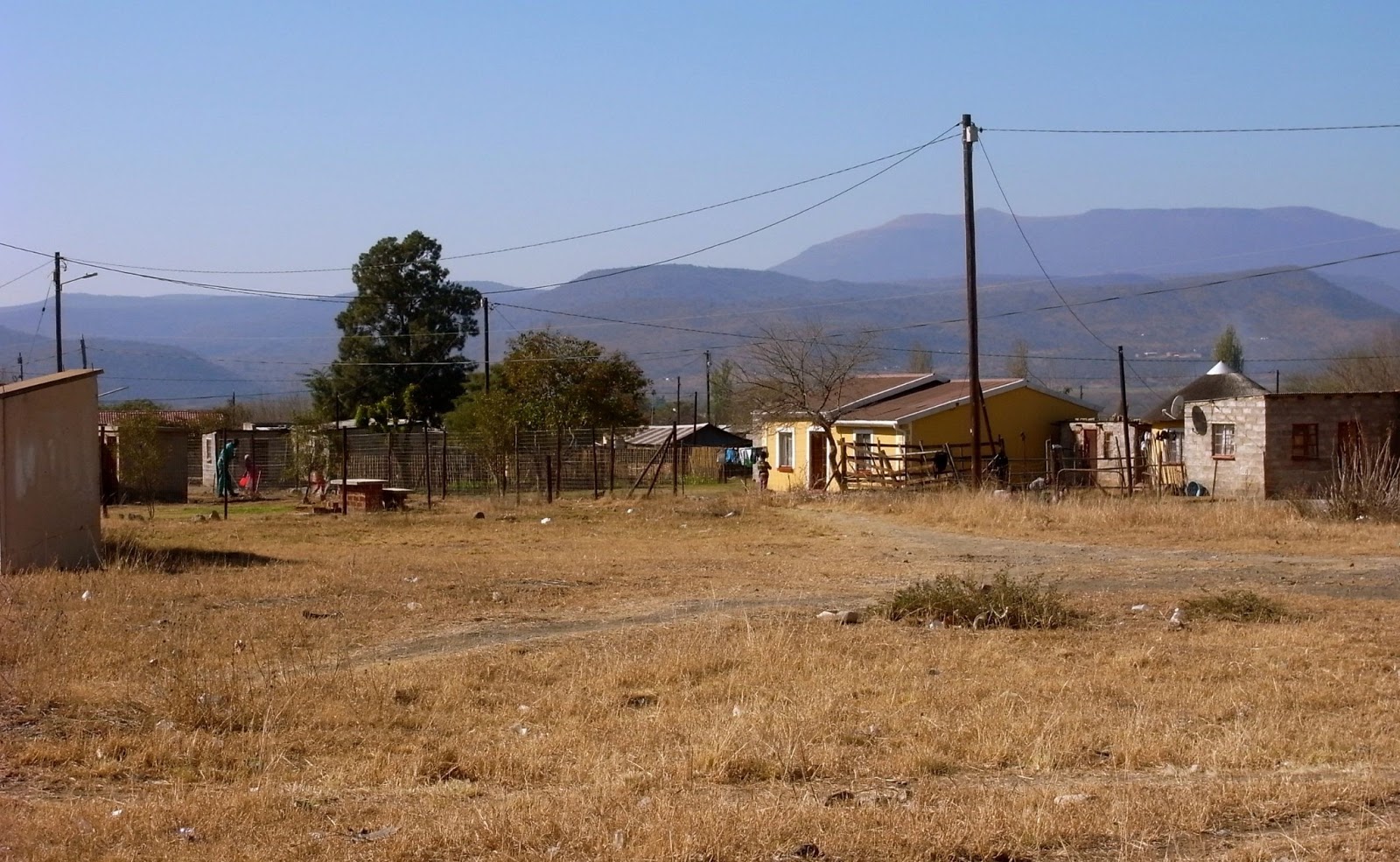
One street away from Sikhona Care Centre, I visited households with Nombulelo, a community care giver (CCG). She had never been to these homes before, but invited me to join her nontheless. I don’t honestly know if I helped or hindered her attempts to gauge what challenges people had and what they needed, but when we went into the first house, it was clear that this woman needed assistance.


One of the houses facing Sikhona Care Centre.
We ducked under a line of barbed wire, moving the flimsy wire and stick gate out of the way. Inside, the hard was shabby, free of grass, a garden or boulders. The one roomed house was roughly painted, cement walls giving way to a wavy tin roof. Once we introduced ourselve to the owner, a woman in perhaps her mid-40s, we were ushered inside. The room served as a bedroom, closet kitchen and storage room. Everything had its place, whether on the floor or piled on top of a night stand or plastic shelving. Although simple and sparse, the room was clean. Light and a bit of warmth poured in from the door. In tiny houses like this one, privacy and security are almost non-existent. Visitors see not only everything you own, but also your life story written across the ragged linoleum floor cover, the neatly made bed and low food stocks. Although this woman did not have much, she took pride in her home. As she cleared space for us to sit—I perched on an over-turned bucket while Nombulelo sat on the bed—it became clear why we were there. This woman, I’ll call her Sisiwe for this story, left her husband and five children some time ago to live alone. Her husband beat her regularly. She lifted her faded gogo-dress to indicated scars along her legs, while demonstrating how she would try to shield her face with her arms, exposing them to blows. As Sisiwe shared, so did Nombulelo. Trust developed as they two strangers shared their life stories and abuses they have experienced at the hands of men. Sisiwe was concerned about the five children she had left with her husband, who was never home and stayed with a girlfriend. Her children had no way of getting food. Nombulelo slowly began jotting down everyone’s name and ID number to report to the Department of Social Development.

Getting into DSD’s system does not mean speedy food parcels or even guarantee them. However, it’s a start. Someone listened to her story. Baring witness and making the necessary referral is what community care givers do here. They come from the same homes as the clients they visit. They try to get folks connected with local services, but are asked for far more than they can deliver. Care givers are on the front lines of poverty in Ezakheni and much of South Africa—they enter into houses where sick folks in tattered clothing and young women alone with four small children ask for help, money, services, counselling and advice.

After a twenty minute visit, we thanked the woman for her time and exchanged farewells in isiZlulu. The third house we visited was just across the dusty street. Two young women in slippers greeted us. They stood up against their house, peering at the newcomers. These women looked young but their bodies and expressions seemed wary, hardened by winter and circumstance. After another round of introductions and unbashed staring at me, they bethened their mother from down the street. We entered the house and sat in a living room area. Like many houses I’ve seen here, the walls met unfinished ceilings and an exposed roof. A dusty desk top computer  was shoved in a corner.  As we sat down, a fluffy black cat wove its way between legs, couches and out into the sunlight. It’s impossible to separate the cold from the nagging feeling of neglect or downright despair that I feel upon entering homes here. No one is comfortable here, people struggle to stay warm, fed and out of disastrous relationships. The girls stood outside of their house as Nombulelo began talking with the mother. These girls loiter all day. They stay outside for the warmth, but do little more than wander around the neighbourhood or yard every day. They look bored, wary and weary at once. They all have questions for me, mostly about who I am, what I am doing here and if they can go to America. I butcher most complex responses in isiZulu, but get smiles in return for my efforts. These girls are younger than me, but wear the hardness of their lives. We smile, look sheepishly away if a gaze is held too long and finally part ways. We only live a thirty minute walk away from eachtoher, but occupy the same space very differently. If they see me on the road I hope they will wave or greet me.

Back at the office, the world map project
I am working on for Idamu Primary School
Nombulelo and I walk back to Sikhona, recapping what I missed in isiZulu and clarifying her role. She is there to meet families or folks living alone, gather basic identification information for DSD and layout the next steps in the process. More than that though, she shares, reaches out and explains options. As we turn the corner, my questions turn to her situation. Nombulelo lives in a separated house with two of her sisters, her son and numerous nieces and nephews. She receives meager social grants for two of the school-aged children, r280 (about $30USD per child per month) and a small stipend from Sikhona Care Centre, currently r1000 every month. As the only family member with steady work, Nombulelo barely gets through the month. She is in the same boat as many of her clients. That is one of the hardest things to wrap my head around. I can’t pinpoint where exactly Nombulelo became a community care giver, but drive something other than a small monthly stipend keeps her going out into neighborhoods looking for people that need help.